Malaysian Cabinet formed but legitimacy crisis continues


May 15, 2013

Malaysian Cabinet formed but legitimacy crisis continues

By Anil Netto

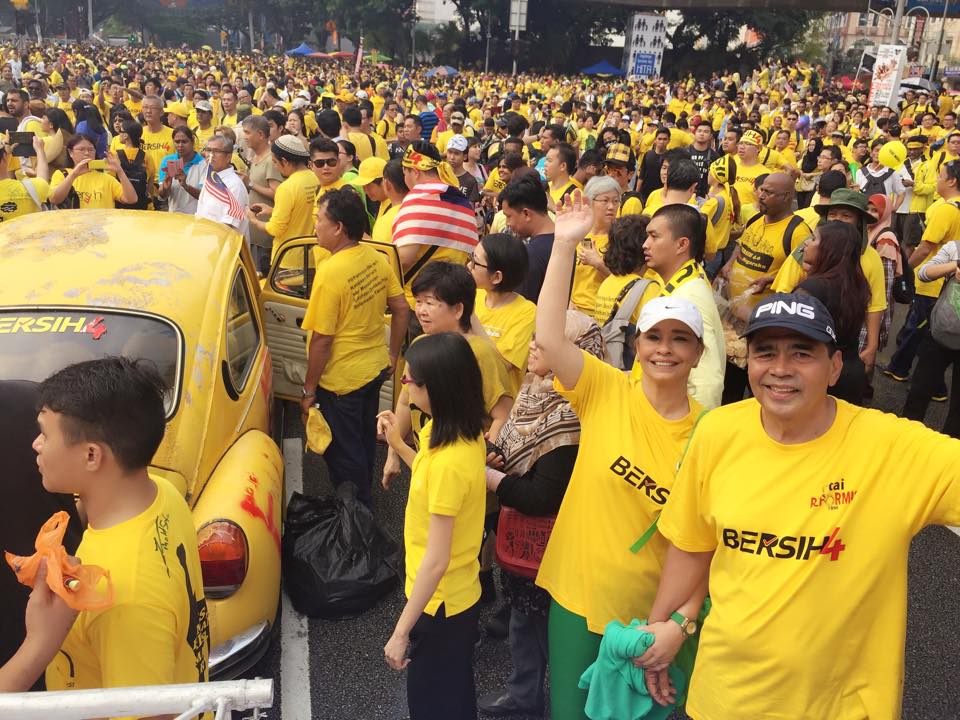
PENANG – Large crowds have turned out in protests in major cities on peninsular Malaysia in response to a general election marred by allegations of irregularities and vote-buying. As the protests spread across the country, the Opposition coalition Pakatan Rakyat’s challenge has the potential to destabilize Prime Minister Najib Razak’s new government.

Despite winning less than half of the national vote, BN now controls 10 out of 13 federal states due to its careful carving of constituencies.

Despite winning less than half of the national vote, BN now controls 10 out of 13 federal states due to its careful carving of constituencies.

In the central state of Selangor, some 100,000 thronged a stadium in the first major protest three days after the May 5 polls. Thousands more attended a simultaneous protest at the Rusila Mosque in Terengganu on the peninsula’s east coast. These were followed by another large turnout of close to 100,000 at another stadium, in the northern state of Penang, on May 11.

On Sunday night, some 30,000 crammed into the streets of Ipoh, the capital of the state of Perak, for yet another rally. More rallies are expected this week, including in Johor Bahru in the south and Kuantan on the east coast of the peninsula. Smaller groups of Malaysians have congregated in cities abroad, including in Melbourne, Taiwan, and Singapore.

malaysian-opposition-leader-anwar-ibrahim-speaks-during-a-rally-at-a-stadium-in-kelana-jaya-selangor-on-may-8-2013-3At all the rallies participants have dressed in black to symbolize a democracy “blackout”. The de facto Pakatan Rakyat (PR) leader Anwar Ibrahim and other coalition politicians have made several rousing speeches decrying fraud and irregularities at the polls. They have also made their case with international audiences, including in interviews with big global broadcasters.

In a campaign that highlighted rampant corruption and cronyism in the ruling Barisan Nasional (BN) coalition, the PR won almost 51% of the popular vote at the polls. But with constituencies gerrymandered to favor less-populated rural areas traditionally held by BN, PR won only 40% of parliament’s 222 seats. (BN captured 133 parliamentary seats to the PR’s 89.)

PR retained the state governments of Penang and Selangor, both developed states that it has governed since 2008, and the rural east coast state of Kelantan and lost narrowly in the northern state of Kedah.

Despite winning less than half of the national vote, BN now controls 10 out of 13 federal states due to its careful carving of constituencies. In Perak state, which PR captured in 2008 only to lose power after a few of its elected representatives defected, the BN won only 43% of the popular vote but still captured the state assembly, winning 31 state seats to the PR’s 28.

Subramaniam Pillay, a steering committee member of the civil society Malaysians protest over GE13 results in Kelana Jaya Coalition for Clean and Fair Elections (BERSIH), notes that the last time constituencies were redrawn was in 2003, and that only a simple majority in parliament and the state assemblies is required to redraw electoral boundaries – though a two thirds majority is required to increase the number of seats.

PR’s three component parties are expected to challenge the results in some 30 parliamentary constituencies where the BN won with small majorities. They have 21 days from the date the results are officially gazetted later this month to submit court petitions.

They could also file more general suits relating to vote-buying and constitutional issues related to the conduct of a caretaker government. Bersih, which has staged massive street rallies in the past against BN’s perceived manipulation of the electoral system in its favor, has said it would set up a “People Tribunal” to investigate the allegations of fraud and irregularities.

UtusanNajib, for his part, claimed a “Chinese tsunami” (a reference to the ethnic Chinese who represent 25% of the population) voted down BN candidates in many urban areas. Utusan Malaysia, owned by Najib’s United Malays National Organization (UMNO) party, took the cue with a headline splashed on its front and back pages asking “What more do the Chinese want?”.

BN’s insistence on viewing the country’s fast-changing political landscape through a race-tinted lens is consistent with its old style of politics, which is theoretically based on power-sharing among race-based political parties in BN but in reality is dominated by the ethnic Malay-led UMNO.

The contrast with the PR’s self-proclaimed “new politics” could not be more pronounced. Multi-ethnic demonstrators have said they represent a “Malaysian tsunami” that wants good governance, clean and fair elections and an end to corruption, and an end to the BN’s practice of exploiting ethnic divisions.

“Some commentators here have missed the whole point: we are not saying the opposition will take over the government or whether the elections results can be verified and fraud detected,” said Jeremiah Liang, who left a comment on a blog. “No. The real change is that the people of Malaysia, from all races and mostly urban, starting with Selangor and then to other states, are saying to the incumbent government: You have lost the people’s mandate to lead and to govern.”

sabmThe Police have responded by threatening to investigate 28 speakers at recent rallies for sedition, an offense, punishable by imprisonment, that the BN has long used to stifle criticism of its rule. The organizers of the various rallies will also be investigated for allegedly violating the Peaceful Assembly Act, which requires they give 10 days notice to the police before staging rallies. Should the government make mass arrests, the situation could tilt towards instability, some analysts believe.

To what extent election fraud, including allegations of voting buying in the crucial North Borneo states of Sabah and Sarawak, can be proven with sufficient evidence to overturn the results remains questionable. PR parties will face significant constraints to scrutiny in interior and difficult-to-access rural areas long controlled by BN politicians.

However, in one significant expose, the social reform group Aliran found people lining up for payments ranging from 150-200 ringgit (US$50-67) over the weekend in a few nondescript locations based on vouchers received before polling day. Some of those lining up for payments but who didn’t receive cash were told they would only receive payment if the BN candidate in their area won.

Others says the real source of fraud lies in the integrity of the electoral rolls. The BN’s granting of identity cards or citizenship documents to migrants in Sabah that allow them to vote had been the subject of a royal commission of inquiry but was postponed ahead of the election.

The Election Commission, meanwhile, has received flak for using indelible ink that disappears with mild scrubbing. With 260,000 military and police personnel eligible for early voting five days before official polling, the issue has raised concerns that BN-loyal security officials may have voted more than once.

The PR’s focus on electoral irregularities and gerrymandering may mask somewhat the coalition’s failure to deliver its clean governance message in grass roots rural areas. Many of the rural voters receive their news from television, radio and newspapers tightly controlled by the BN-led federal government, while few have access to more independent Internet-based news.

If PR did get its message across, it may not have resonated with rural voters as it did with urban ones. For instance, its pledges to reduce highway tolls, provide free higher education and usher in good governance lacked popular resonance in remote areas of Sabah and Sarawak where direct BN populist hand-outs maintained voter loyalty.

Among rural voters and some urban voters there were no doubt concerns that they would lose out if the BN’s affirmative action policies were replaced by the PR’s promise of more meritocracy in the distribution of state funds. While PR had indicated it would adopt a more needs-based – rather than race-based – approach, old insecurities remain.

Other weaknesses in the PR campaign included disputes over seat allocations among component parties that led to several multi-cornered contests that split votes in pro-PR areas. The late selection of PR candidates also gave them little time to familiarize themselves with the area and electorate in Malaysia’s short campaign period.

Despite these weaknesses, Anwar has announced plans to hold more ralliesMalaysia's Political Comeback Kid-2013. While it still seems unlikely these will morph any time soon into a larger Arab Spring-like movement that overturns the result, the rallies and the allegations add to the pressure on Najib, who is clearly struggling to come to terms with the erosion of BN popular support.

Anil Netto is a Penang-based writer.

http://www.atimes.com/atimes/Southeast_Asia/SEA-01-150513.html

Prime Minister Najib’s Cabinet, 2013


May 15, 2013

Prime Minister Najib’s Cabinet, 2013

One can be relieved that despite controversies surrounding UMNO-Barisan Nasional victory in GE-13, Prime Minister Najib has finally a Cabinet of his own. He can now proceed to honour his election pledges and continue his transformation agenda. He has taken more than a week to announce his Ministers, Deputy Ministers and Political Secretaries. The delay was due to efforts to persuade MCA and Gerakan to join his Cabinet.

His Cabinet line up is (see below):-

The Najib Cabinet, 2013

Malaysiakini reports (May 15, 2013):

Quote: Prime Minister Najib Abdul Razak unveiled his “transformation cabinet” this evening, which included a P Waythamoorthy (below) of Hindraf as a Deputy Minister in the Prime Minister’s Department.

hindraf 5th anniversary 251112 waythamoorthy waytha moorthyIt also included UMNO Youth chief Khairy Jamaluddin who was overlooked in the last cabinet – he is tapped as sports and youth minister.

No one from MCA and Gerakan has been included in the new cabinet. However, Najib said that the door is still open to MCA participation if the party amends its decision not to participate in the cabinet.

Another surprise was the appointment of Transparency International-Malaysia President Paul Low (below) as Minister in Prime Minister’s Department.

Maybank Berhad Chief Executive Officer Abdul Wahid Omar was roped in as a Minister in the Prime Minister’s Department, and most probably will be in charge of Economic Planning Unit.

However, Najib did not name the responsibilities of the six Ministers in his department, an increase of one compared to his previous cabinet.

The Transport Ministry is understood to be the Ministry allocated for MCA, which will be helmed by Hishammuddin Hussein. NONEAnother new face in the cabinet is Abdul Rahman Dahlan, who has been named local government and housing Minister.

This cabinet also sees a merger between the education and higher education ministries.

Najib unveiled his cabinet at his office at 5pm. The announcement, Najib’s first official action as head of government following the May 5 general election, was telecast live by local TV channels.

Najib had earlier submitted the cabinet list to the Yang di-Pertuan Agong and said his Majesty had given his approval to his cabinet list.

“I believe this is a balanced cabinet. It’s a balance between the experienced, technocrats and young leaders,” he said. As for MCA’s resolution not to take up government positions, Najib said that MCA has to amend its resolution before it can participate in the cabinet.

“If they re-consider later, we have a ministry post ready for them,” he said, referring to the Transport Ministry.

Najib’s new cabinet is heavily dominated by UMNO with 20 ministers, while PBB (Sarawak) has 4, MIC, 2, PRS (Sarawak), PBRS, PBS and UPKO (Sabah), 1. Three ministers, all of whom are in the PM’s Department, have no party affiliation. Unquote.

Tunku Abdul Aziz– Ethics Advisor to the Cabinet

I personally had expected that Tunku Abdul Aziz (right) would be a Minister in the Tunku AzizPrime Minister’s Office. He is well qualified to join the transformation team given his wide experience on issues of governance, ethics and corruption. He was the man who started Transparency International-Malaysian Chapter.

Tunku Aziz was also Ethics Advisor to Secretary-General Kofi Annan at the United Nations. It is unfortunate that Tunku Aziz is not chosen.He would be well suited to be in charge of Ethics Office in the Prime Minister’s Department.

However, we can take comfort that Dato Paul Low of Transparency International-Malaysia Chapter and formerly with the Federation of Malaysian Manufacturers has joined the Cabinet as Minister in the Prime Minister’s Department. Let us hope Dato Low will be able to help Dato Seri Idris Jala in fighting corruption and abuse of power in public administration.

Tengku Razaleigh for National Reconciliation

Ku LiNajib should have tapped the expertise of Gua Musang’s Tengku Razaleigh Hamzah. The Kelantan Prince would be ideal to promote national unity and bring about national reconciliation after a very hot contested and divisive election. He has access to key personalities in the political Opposition and can serve as the link between Government and the Opposition.

Obviously, the Prime Minister has other ideas. Perhaps both Khairy Jamaluddin at the Sports Ministry and Shabery Cheek at Communications and Multimedia can probably play that role through sports and multimedia communication.  This would mean that both Khairy and Shabery would have to complement each other.

Overall, I think that the Prime Minister has been able to make the best use of talent available to him. I wish him and his Cabinet all the best. Remember Accountability first and now. –Din Merican

______________________________

The new cabinet, by party and in numbers

8:39PM May 15, 2013www.malaysiakini.com

Non-BN Ministers and Deputy Ministers:
Idris Jala (Sarawakian, no party affiliation, retained)
Paul Low (Transparency International-Malaysia president, new)
Abdul Wahid Omar (Maybank chief executive officer, new)
P Waythamoorthy (disputed Hindraf chief, deputy minister)

Ministers in previous cabinet dropped:
(Excluding MCA and candidates who lost or did not contest GE13)
Shaziman Abu Mansor
Noh Omar
Koh Tsu Koon, Minister in PM’s Department

Gender composition:
Two women ministers out of 35 ministerial posts and four women Deputy ministers out of 26 Deputy ministerial posts. In total, six women out of 61 posts. In the last cabinet announced in June 2010, there were also two women ministers and three deputy ministers.

East Malaysia and Peninsula composition:
Ministers:
East Malaysia: 13 (Sarawak 8, Sabah 5) – (6 in last cabinet, Sabah 4; Sarawak 2)
Peninsula: 22 – (25 in last cabinet)
Total: 35 – (31 in last cabinet)

Deputy Ministers:
East Malaysia: 8 (Sabah 4; Sarawak 4)
Peninsula: 18
Total: 26

The highest number of Ministers from Sabah and Sarawak:
1) Joseph Kurup (Sabah/PBRS) – Prime Minister’s Department
2) Joseph Entulu (Sarawak/PRS) – Prime Minister’s Department
3) Nancy Shukry (Sarawak/PBB) – Prime Minister’s Department
4) Idris Jala (Sarawak/Senator) – Prime Minister’s Department
5) Anifah Aman (Sabah/Umno) – Foreign Affairs
6) Fadilah Yusof (Sarawak/PBB) – Works
7) Richard Riot (Sarawak/SUPP) – Human Resources
8) Ewon Ebin (Sabah/Upko) – Science, Technology and Innovation
9) Maximus Ongkili (Sarawak/PBS) – Energy, Green Technology and Water
10) Douglas Uggah (Sarawak/PBB) – Plantation Industries and Commodities
11)Rohani Karim (Sarawak/PBB) – Women, Family and Community Development
12) Shafie Apdal (Sabah/Umno) – Rural and Regional Development
13) Abdul Rahman Dahlan (Sabah/Umno) – Housing and Urban Well-being

Party breakdown of Ministers:
UMNO: 21 (same as last cabinet)
PBB: 4 (1)
MIC: 2 (2)
PBS : 1 (1)
PBRS: 1 (0)
PRS: 1 (0)
Upko: 1 (1)
SUPP: 1 (1)
Non-BN: 4 (1)
Total: 35 (31)

Party breakdown of Deputy Ministers:
Umno: 17
MIC: 2
PBB: 3
PRS: 1
Hindraf (NGO): 1
PBS: 1
PPP: 1
Total: 26

Chinese and Indian representatives:
Chinese: 2 (1 Minister and 1 Deputy Minister; down from 6 ministers and 10 Deputy Ministers in last cabinet)
Indian: 6 (2 Ministers and 4 Deputy Ministers; the same as in the previous cabinet)

BN’s polls slump a ‘Malaysian tsunami’,says Pak Kadiaq


May 6, 2013

BN’s polls slump a ‘Malaysian tsunami’,says Pak Kadiaq

http://www.themalaysianinsider.com

Dato dengan berokBarisan Nasional’s (BN) weaker showing in Election 2013 points to a strong wave of rejection from all Malaysians and not just from the minority Chinese, a former editor of the UMNO-owned New Straits Times said today.

Datuk A. Kadir Jasin observed that the 13-party coalition not only drew fewer seats in the 222-member Dewan Rakyat and 12 state assemblies in yesterday’s general election compared to 2008, but also lost the popular vote for the first time since polls in 1969.

“Is it not possible that this is not a Chinese tsunami or racial chauvinism but a Malaysian tsunami that is centred on the aspiration and new reality, especially among young voters?” the man who had been group editor-in-chief of the public-listed News Strait Times Press during the Mahathir administration wrote in his blog.

BN chairman Datuk Seri Najib Razak had alluded to a “Chinese tsunami” in an immediate speech just after midnight when the Election Commission announced the BN as winners by a simple majority, but the veteran journalist today brushed aside the perception as unlikely.

Kadir highlighted that BN took a severe beating this round and bled morePrime Minister Najib seats at both the federal and state levels compared to 2008, leaving it with only 133 federal seats and 274 out of the 505 total state seats despite wresting back Kedah from the Pakatan Rakyat (PR) pact.

It also prevented Perak from falling back to PR, but nearly lost Terengganu and was forced to cede many seats in Johor, the birthplace of anchor party UMNO and the state it considered a vote bank.

He also noted that despite the three-party PR alliance’s failure to nab Putrajaya, it succeeded in enlarging its presence in Dewan Rakyat.The DAP, PKR and PAS union won 89 federal seats compared to the 82 it had in hand previously.

Kadir cautioned the newly-sworn Prime Minister and the latter’s coalition against feeling proud of their achievements or being stubborn when carrying out necessary reforms.

“Najib was stunned by the decision and promised change to his UMNO party. But the BN performance that was worse than in 2008 has made his position wobbly,” he warned.

He also advised the PR pact to accept their loss graciously, and to resolve their disputes through legal channels instead of resorting to street protests.

The BN succeeded in keeping its 56-year unbroken grip on federal power for another five-year term, but allegations of vote-buying and electoral fraud were among other voter irregularities that have cast a shadow on Najib’s administration.

Anwar IbrahimHis rival for the premiership, Datuk Seri Anwar Ibrahim, has questioned the legitimacy of the BN mandate, which he claimed was obtained fraudulently in yesterday’s polls and vowed to challenge the results.

Election watchdog BERSIH also said it will withhold recognition of BN’s victory until they have verified reports of electoral fraud.Malaysia’s voter turnout hit an all-time high of 80 per cent according to the Election Commission.

GE-13: It’s All About Najib


April 30, 2013

GE-13: It’s All About Najib

by Jose Barrock  & S Ashwiinie

Premier Najib Abdul Razak, comes across as a well-bred gentleman – he speaks well, is very polished, always in pristine suits and the hint of a clipped English accent adds to his allure. But he wasn’t always this way, so polished— he has in the past played many roles, an angry young man, the king maker, and many others, some of which we at KiniBiz will explore.

Najib-money-300x175Turn back the clock, it’s October 1987— trendy Malaysians from all walks, hang out at the Tin Mine Discotheque in the Kuala Lumpur Hilton, (now the Crowne Plaza), the Bee Gee’s “You Win Again” is atop the charts, while the late Michael Jackson’s “Bad” has just been released—ripping speakers everywhere.

Despite the apparent calm in the streets, there were serious racial problems sprouting up in Malaysia.

An angry young man 

The appointment of non-Chinese educated personnel in Chinese schools resulted in a gathering of some 2,000 odd Chinese led by the association of Chinese school teachers and trustees or Dong Jiao Zong, in Kuala Lumpur. This group was joined by politicians from the Malaysian Chinese Association or MCA, Democratic Action Party known as DAP, Gerakan and other Chinese associations and parties.

Politicians from both sides of the divide—the MCA being the second largest member of the ruling Barisan Nasional coalition, and opposition stalwarts DAP—quickly charged up the crowd, racial slurs were made and a plan was put in place to boycott Chinese schools.

Interestingly enough Dong Jiong Zong and some of the other Chinese associations were asking for the resignation of then Education Minister, Anwar Ibrahim.

This occurred on October 11, 1987. Six days later— in retaliation—- a 34 year old Najib who was the head of UMNO Youth led a 10,000 strong rally, in the TPCA (Tamilians Physical Cultural Association) Stadium in Kampung Baru and is purported to have called for the Malays to bathe the keris (a Malay dagger) in Chinese blood.

This eventually led to Ops Lalang (weeding ops) on October 27, 1987— where 106 individuals were arrested under the Internal Security Act (ISA), and two publications, The Star and Sin Chew Jit Poh’s  had their publishing licenses revoked.

Najib however has denied this entire Chinese blood and keris episode, saying he never urged the unrest. “Many think that it is his cousin Hishammuddin (Hussein) who started the keris brandishing and waving act at UMNO Youth gatherings….it was actually Najib who started it… It’s an UMNO Youth thing,” a local politician, and a Ketua Bahagian of UMNO said.

A seasoned politician at 34

“It is like that…when you go for an MCA or DAP meeting they (the members) are very racist as well, you think they are singing the praises of Malays at their meetings?

“If you go to an MIC meeting also it’s the same, but somehow when Malays do anything it gets blown out of proportion,” the UMNO politician said.

While some may attribute the episode of Chinese blood and keris to Najib being young, the fact of the matter is at 34 years old, he already had plenty of experience in politics.

In 1976 when his father Abdul Razak passed away, Najib who was 23, was selected to run for the Pekan parliamentary seat left vacant by his father’s death. And of course he won.

His first stint in the Cabinet was at the age of 25 when he was appointed Deputy Minister of energy, telecommunications and post in 1978—making him the youngest deputy minister in the country. He had a whole host of ministerial portfolios from the age of 32.

Also at the age of 29, he was Menteri Besar of Pahang, a position he held for four years from 1982.Nevertheless some have also questioned who Najib’s political mentors are. This question arises due to his closeness to Anwar who he faces as the head of the opposition today in the 13th General Elections.

Closeness to Anwar  

Najib has had good ties to Anwar before. His position in 1987 as UMNO ???????????????????????????????????????????????????Youth head was a result of Anwar moving up the food chain, going for an UMNO Vice President’s position, and thus nudging Najib up.

Interestingly enough Najib was part of Anwar’s Team Wawasan in 1993, together with Muhammad Muhd Taib and Muhyiddin Yassin. All three were UMNO Vice Presidents, while Anwar strengthened his position to Deputy President of UMNO, when incumbent Ghafar Baba withdrew from the fight for the number two position.

Some also say that Najib’s meagre 231 seat victory in Pekan in the 1999 General Elections was a result of many showing their unhappiness with him supporting Premier Mahathir Mohamad, and parting ways with Anwar who had since been sacked.

Najib plays kingmaker

There was massive infighting in UMNO in 1987, and Najib was involved in the thick of action. A year ago, in 1986, Musa Hitam the Deputy Premier stepped down saying Mahathir no longer trusted him. Then in April of 1987, Tengku Razaleigh Hamzah and former deputy premier Musa Hitam took on Mahathir and his Deputy Ghafar.

Dr Mahathir-nstMahathir won by a mere 43 vote majority—-garnering 761 votes while Razaleigh  managed 718 votes. A swing of a mere 22 votes would have altered Malaysia’s history.

Insiders say, Najib had privately backed Razaleigh, but at the 11th hour he switched camps to support Mahathir, giving the incumbent the win. They add that Anwar had played an important role in turning Najib against Razaleigh and Musa, and thus benefit Mahathir.

“I’m sure many wonder what would have happened had Najib not switched allegiances…Mahathir may not have won—Malaysian history would be very different from what it is today,” a local politician said.

While his political life panned out well in the early years, the later part of it has been tumultuous to say the least, with accusations that he was involved with a Mongolian model who was murdered.

Altantuya Shaariibuu’s murder

In 2006 the entire nation was shocked when details of Mongolian model Altantuya Shaariibuu’s murder came about— especially the use of explosive substances such as C4, which are close to impossible to get on the open market, and the involvement of policemen who were assigned to the Prime Minister as bodyguards.

Najib’s aide and associate Abdul Razak Baginda was among those charged but was later acquitted. The prosecution did not appeal. Stories circulated that Altantunya was also known to Najib but Najib strenuously denied this.

Altantuya and Razak Baginda, who were emotionally attached, were said to be involved in an arms deal where Malaysia acquired Scorpene submarines from France, with the latter making high commissions from the deal.

“When you talk about arms deals there is a lot of secrecy, it’s all classified under OSA (Official Secrets Act) so there are no questions asked….it all falls under defence spending, so it’s easy money to be made…some say the whole Altantuya fiasco, is a deal gone bad,” a politician said.

Certain quarters have tried to link Rosmah Mansor— Najib’s wife to the murder, but there is no evidence to prove this.

Rosmah, an albatross around Najib’s neck

“In any political exchange, or discussion her name keeps coming up, and notRosmah Mansor in a flattering manner…earlier UMNO politicians defended her….now they don’t bother,” the politician said.

She has been in the spotlight for all the wrong reasons. There is talk about her being involved in decision making at the highest levels, brokering deals, and living it up spending on accessories and jewellery.

Some say she is also close to the likes of Desmond Lim’s wife Tan Kewi Yoon, and steel magnate William Cheng’s wife Chelsea as well, explaining to a certain extent why the two businessmen can’t seem to do any wrong in corporate Malaysia.

Also through the grapevine was her purported involvement in awarding of the RM8 billion Gemas-Johor Bahru double tracking rail job.

As one official from a public listed company said, “It’s very seldom that almost the whole country is united against someone…strangely enough in this case it’s the PM’s wife.”

Other issues—1MDB, FELDA

More recently Najib’s 1Malaysia Development Bhd (1MDB) has hit the headlines for all the wrong reasons. 1MDB has issued some RM20 billion worth of bonds with very high coupon rates, but has little or nothing to show for it. The company has come under fire.

Some of its partners such as PetroSaudi International are just as opaque, leaving many questions unanswered. Also 1MDB has come out to say that it has RM7 billion in investments in the Cayman islands—- which is safe. This has irked the investing community even more, as they wonder why the money is not transferred back to Malaysia, and with some even questioning why 1MDB was set up in the first place.

Meantime there have been mixed reactions to the Felda Global Ventures Holdings Bhd (FGV)’s floatation exercise, which was the second largest IPO after Facebook last year, and raised some RM9.9 billion. According to certain quarters the settlers, although they received cash, were given the shorter end of the stick with the massive ownership dilution of the company.

Profundo Economic Research in a report released in June last year, prior to FGV’s floatation exercise stated that, “Our analysis shows that an accumulation of environmental, social and governance risks will result in serious financial risks for investors.” It had an avoid call on FGV’s stock.

Since a surge to almost RM5.50 after its RM4.60 IPO, FGV’s stock has tapered off and been largely trading below that for most of the the year.

Good deeds— too few and far in between?                     

The UMNO politician said, “Who is the President of MIC (Malaysian Indian Congress), who is the President of MCA (Malaysian Chinese Association)….I tell you it’s all Najib….he’s the only hope for Barisan Nasional,” the politician said.

It is true, Najib has been in the forefront, using his own popularity to prop up both the MCA and MIC which are ailing parties.

Also to Najib’s credit economy-wise, Malaysia has been performing better than many other countries in the region. This year Malaysia’s growth is estimated to be in the region of five percent.

Last year the economy expanded by a 5.6 percent quantum as domestic demand recorded the highest rate of expansion over the decade buoyed by strong consumption and investment spending.

According to reports, overall investment by the private sector was the key driver of domestic growth in 2012. Private investment was strong contributing about 15.5 percent to GDP (gross domestic product – goods and services produced) and registering growth of 22 percent, while public investment grew 17.1 percent from higher capital spending by public enterprises.

In contrast global growth moderated in 2012, amidst the challenging economic climate. Much of these can be atrtributed to Najib’s plannning. From January 2010 to March 2013, he set up several programmes under the economic transformation project (ETP), slated to benefit the people and rightly targeting the lower income group.

ETP

The ETP which is under the belt of the Performance Management and Delivery Unit is tasked with creating a Gross National Income of US$523 billion by 2020, and increase per capita income to US$15,000 from US$6,700 in 2009.

He also set up several other initiatives which directly benefit the general populace. Among others, 1Malaysia Clinic was set up whereby treatment and medication cost only RM1, the 1Malaysia People’s Shop and the 1Malaysia People Housing Project (PR1MA), for those aiming for their first home.

Under Najib’s watch as well, work on the RM30 billion— Mass Rapid Transit System or MRT— has started.

The 1Malaysia People’s Aid (BR1M) is another of Najib’s trademarks, where cash payments of RM500 were made to needy individuals. From 2011 to 2012, approximately 1.1 million job opportunities were created.

Perhaps the landmark decision of his career is the abolishment of the Internal Security Act which is now replaced by the Security Offences (Special Measure) Act 2012 (Sosma). Najib also comprehensively reviewed the Printing Presses and Publications Act 1984 as well as the Sedition Act.

Malaysia also fared better in Transparency International’s 2012 Bribe Payers Survey.Thus Najib seems to have done well on some fronts.

Some of the unaddressed, unanswered issues 

However during Najib’s watch as well, household debt to gross domestic product (GDP) reached RM667 billion or 77 percent of GDP which is high.

More recently questions of national security arose, after some 200 militants parked themselves down in Sabah and declared parts of the region theirs.“Imagine if you and I and a few friends walked into Singapore, bearing arms….we’d be dead in minutes,” a market watcher said.

There are also those who wonder why under Najib’s watch one individual, Syed Mokhtar Albukhary has amassed so much wealth. One of his flagship companies, DRB Hicom Bhd is based in Pekan, Pahang, which is also Najib’s constituency.

Recently there was a huge hue and cry that tycoon Robert Kuok Hock Nien had bought a parcel of land in Johor, and is to develop property in the Iskandar Malaysia. Is it really a big deal when Kuok who was born and bred in Johor buys a plot of land to develop?

Looking forward

Moving ahead, Najib’s plans for the country are already largely in place with heavy investments in rail projects, oil and gas, construction, property and water among others. However for Najib, his long term plans for the country could be derailed by his current deputy, Muhyiddin Yassin.

PTJ04_070110_TPM-2010Certain quarters in UMNO say that Najib’ has to either gain two thirds majority or win back Selangor, both seemingly tough targets to achieve, to continue being prime minister. Otherwise he is likely to be challenged by Muhyiddin.

It is also clear that Muhyiddin has the support of former premier Mahathir which is very important, and to top it all Muhyiddin’s grass root support in Johor is strong.

While Muhyiddin has always been coy, and never openly said he was after Najib’s position, he could be thrust into the number one seat, if he garners more support than Najib.

However much of the fight at the UMNO level will be sorted out in the third quarter of 2013 at the UMNO General Assembly.  Najib seems to have his hands full, having to look over his shoulder at Muhyiddin, campaign for UMNO, MCA and MIC, and running the country.

He has been Prime Minister for four years without a direct mandate from the people. Will the people now endorse him for the next five years?

Najib disputes survey findings of UMCEDEL


April 28, 2013

Najib disputes survey findings of UMCEDEL

by Lu Wei Hoong@http://www.malaysiakini.com

BN chairperson Najib Abdul Razak has rubbished a survey conducted by a department within Universiti Malaya which claimed that he is four points behind PKR de facto leader Anwar Ibrahim.

Survey finding of UMCedel

“I don’t agree with the poll. We have our own poll. My poll indicates that we are ahead,” he said. He said this at a press conference after attending a luncheon involving 1,000 people in Rawang, Selangor.He was referring to the UM’s Centre for Democracy and Elections’ (Umcedel) recent survey where 43 percent of respondents believed that Anwar was to be qualified to be prime minister, compared to 39 percent saying the same for Najib.

Some academics have questioned the survey results, claiming that the sample size of 1,407 was too small and that Pakatan Rakyat may have manipulated the survey results.

Sabotage

Najib latestNajib added that he was confident that BN will win with a two-thirds majority in Parliament, provided that BN is not subject to internal sabotage.

“But I have to remind that the internal problem must be resolved or else it may threaten our performance (in the general election).If we are united and working hard, there is no reason why we can’t get good result,” he said.

Asked on the BN’s performance in the Pakatan Rakyat states, Najib admitted it is an uphill battle. “We know that it is not easy to change the state government but our machinery is in high spirit and we will do our best to achieve our objectives,” he added.

Johor

Regarding his appearance with his lieutenant Muhyiddin Yassin in Johor tomorrow, Najib dismissed that it is an indication that BN was in a precarious position there.

“No. We know that Johor is a battlefield as DAP leaders have chosen it (as a frontline state). We are not only concentrating on Johor. We will travel to every state… to achieve an overall victory.”

Bakri Musa on GE-13: First of Four Parts


April 8, 2013

Bakri Musa on GE-13:

Elections: A System for Checks and Balances

[First of Four Parts]

NajibWhen he dissolved Parliament on April 3, 2013, to make way for a general election, Prime Minister Najib advised us to “think and ponder appropriately” before casting our votes.

We can practice two mental exercises to help us “think and ponder appropriately.” One, imagine the best and worse possible consequences of our vote, that is, perform a “downstream analysis” of our decision. Two, reflect on the greater role of election as an effective bulwark against abuse of power by those in authority.

I will discuss the broader role of elections first. Subsequent essays will be a downstream analysis of the only three possible outcomes to this election:  Barisan Nasional returning to power; Pakatan Rakyat to prevail; and a “hung” parliament.

The most effective check on those in power is the knowledge that they could be replaced in an election. The more this is a reality and not just in theory, the more effective is this critical role. Elections serve as periodic useful reminders.

Even where elections are fair and free, but if the same leaders and party were to be re-elected over and over, they would sooner or later succumb to sclerosis and abuse of power, regardless how competent and well meaning they were initially. It is the rare leader who could escape this all-too-human tendency. We must have actual periodic change in government through elections, and not just the promise.

With rigged and fraudulent elections, or where the process is merely illusory, as with having only one candidate per slot (Russian elections of yore and the election of UMNO President), the less effective they would be in keeping those in power accountable. Saddam Hussein bragged that those who did not like him could always vote him out, but Iraqi elections under him were a sham. Had he kept those elections honest, he would have discovered his people’s true sentiment much earlier, and the price to both him and his country would have been considerably less.

The British decided through elections that their popular and effective wartime leader Churchill would not be the best person to lead them during peacetime. They wisely concluded that he would quickly turn the Cold War into a “hot” one, as reflected by his hawkish and haughty Iron Curtain speech on March 5, 1946, at Westminster College in  Fulton, Missouri.

Yes, the British were grateful to him for leading and inspiring them during the war, but that gratitude could be expressed in many other ways. Elections are for selecting the best future leaders, not for expressing gratitude for or rewarding past performance, no matter how exemplary.

Foremost and at the practical level, election is a way to pass judgment on the incumbent. It is not, as some have suggested, a contest between the incumbent and challenger. It is for the incumbent to prove that he deserves another term independent of the merit or capability of the challenger. The incumbent’s performance is a matter of record, and can be readily scrutinized.

BN Manifesto 2013

If the incumbent has proven to be less than capable, then he should be voted out even if the challenger is thought of as potentially not up to the task of taking over. The argument would be that the incumbent has proven himself incapable while the challenger is only regarded (meaning, only potentially) as such. There is the possibility that our initial assessment could be wrong and that the challenger would prove otherwise. There are many ready examples of previously underrated candidates later shining in office; Harry Truman being one.

The first and only question voters must ask before casting their votes in this next election is whether the current Barisan government is deserving of another term. All other matters, as whether other parties are capable of taking over, are irrelevant and besides, conjectural.

Consider three critical areas:  economy, education, and level of corruption. Barisan’s economic leadership is passable, not spectacular. It is exemplary only when compared to that of Zimbabwe. Granted, by the figures Malaysia outperforms America and Western Europe (and even Singapore), but remember those countries are already cruising at high altitude. We are still ascending. We need faster growth. We should compare ourselves to China and Panama. Even Ghana and Laos surpassed us last year.

More pertinent especially to those under the sway of PERKASA andibrahim ali perkasa Ketuanan Melayu, is the aggregate economic performance of Malays. After nearly six decades of UMNO rule, we still could not achieve our modest 30 percent goal.

Then there is education. No one, not even the Minister of Education himself, is satisfied with our schools. Those who can afford it have long ago abandoned the national stream.

Again looking from the PERKASA and Ketuanan Melayu angle, only poor Malays are stuck with that rapidly declining system. Consequently, while a generation ago I could still find many Malays at the leading universities of the world; today Malays there are as rare as honesty among UMNO politicians.

The much-heralded growth of the private sector in education is not a sign of health rather the contrary. It reflects a deteriorating public system. Alberta and Singapore do not have robust private-sector education because their public systems are so much superior.

Talking about corruption, well, there is no point dwelling on it anymore. We are past the tipping point; we are now where Nigeria was in the 1980s. The only way to stop corruption is to deprive UMNO of power. The recent Court of Appeal decision granting one Eskay Abdullah, an UMNO strongman and a member of the slimy “Datuk T’s” trio, his RM20 million “commission” on the aborted crooked bridge in Johor reflects the rot in UMNO. We cannot blame non-Malays for seeing that as the characteristic of contemporary Malay politics and ethics.

Elections are like multiple choice tests, to pick the best candidate from the list offered The incumbent always argue that his past performance had been superior or at any rate better than what his opponents could ever hope to achieve; the challenger offers the promise of a brighter future. Voters have to balance the risk of changing horse midstream versus being stuck with a lame one to face an incoming flood.

Malaysians already know how lame our current horse is. Worse, it has a voracious appetite that is severely taxing us, literally and figuratively. This next election is an opportunity for Malaysians to send this lame one to the glue factory and hitch our ride on a new vigorous steed.

There is only one effective way to teach those who have long been in power and grown arrogant into believing that they are destined to rule forever, and that is to vote them out of office. Then even if their successor were to prove less than satisfactory, it would still have served a salutary lesson on both.

Mexico’s PRI of today is a much superior political party and led by a muchEnrique_pena_nieto younger, more capable and decidedly less corrupt leader (picture right, President Ernesto Pena Nieto)  than it was a decade ago when it was booted out after having been in power continuously for the preceding 71 years.

Those who believe that UMNO is “rotten to the core,” no amount of calls for transformation and reform from within or without would be as effective as throwing the party out.

Malaysia has another equally important reason to see regular changes in government. Stated briefly, it is to teach our sultans specifically and the permanent establishment generally the important lesson of being politically neutral. They cannot bank on or be overly cozy with the ruling party That our sultans and civil servants have yet to learn this crucial lesson of democracy was demonstrated by the ugly political mess in Perak, and to a lesser extent in Selangor and Trengganu following the last election.

Duli Tuanku Sultan Kedah Darul AmanIt is also for this reason that I am optimistic of a smooth transition at the federal level with the coming general elections should Barisan be booted out. We are fortunate to have Kedah’s Tuanku Sultan Abdul Halim as Agong (King), not because he had that role earlier, rather his recent experience with the smooth transition from UMNO to PAS in his home state following the 2008 election. His performance then shamed his brother rulers in Perak (especially), Selangor, and Trengganu.

Our sultans and members of the permanent establishment too need frequent reminding on the need to be politically neutral and to be professional about it.

Next:  Second of Four Parts:  Downstream Analysis – A Barisan Win is No Victory for Malaysia

______________

Bakri Musa

Dr M. Bakri Musa is a prolific author and political analyst-commentator. By profession, he is a California-based surgeon. His latest book, Liberating the Malay Mind published by ZI Publications, is now on sale in major bookstores through out Malaysia.

Najib courts the Chinese Vote for 1Malaysia


April 7, 2013

Joceline is Back

Najib courts the Chinese Vote for 1Malaysia

by Joceline Tan@http://www.thestar.com.my

joceline2The Prime Minister is still going after the Chinese vote because he wants them to come along with him on his 1Malaysia journey.

DATUK Seri Najib Tun Razak’s schedule has been so jam-packed over the last few months that when he had a makan outing with his family last weekend, it made news in all the media.

Their presence at an outlet known for Penang hawker food caused such a stir that the Prime Minister spent more time shaking hands with well-wishers and posing for photographs than on the food. It will be a while more before he can enjoy time off with his family because his schedule is about to get super busy.

The long wait is over. Parliament has been dissolved, the state legislative assemblies have followed suit and it is all systems go from here. The stage is set for GE13, the most awaited and what many expect to be the most intensely fought general election in the country’s history.

“This is not going to be a simple contest. It is like a war this time. The other side has resources, it is hungry for power and cannot be underestimated,” said MCA central committee member and lawyer Datuk Ti Lian Ker.

2 PMsThe dissolution of Parliament took place on the date Najib was sworn in as Prime Minister four years ago. It was a timely reminder of his arduous journey to put his party and coalition back on its feet after the 2008 debacle, the policies and reforms he has initiated and the direction that he intends to take this country.

Najib’s schedule has been so hectic that he has shed most of his excess weight. When he posed for photographs with some senior editors in his office on Friday, he was the slimmest person among them.

His paunch is gone, he looks fit and is in great shape. He has lost 6kg over the last couple of months and during the formal photo shoot, his suit needed to be pinned up at the back.

His national standing is also looking good. His approval rating is at an all-time high and climbing. His report card is on the table for all to assess. The momentum is with him and he wants everyone to come along with his 1Malaysia vision.

But he is not complacent and tells everyone that he is “cautiously optimistic”.One reason is the Chinese vote – they are still floating out there. The Chinese say they like Najib but they still think they want to put Umno in its place.

But he has not given up trying to win them over even now as he is approaching the eleventh hour.

Last week, he met up with a delegation from Dong Zong, the Chinese education body that wields a lot of influence over the Chinese. He gave them his word that his administration is seriously looking into their request for the United Examination Certificate (UEC) to be recognised by the Government. The UEC issue has been a long standing thorn of contention and it does look like the matter is about to be resolved.

Last month, Najib hosted a fund-raiser for the Chong Hwa High School in Kuantan alongside no less than well-known movie star Jacky Chan. It was probably one of the most well-attended fund-raisers in history. A total of RM13.5mil was raised for the Chinese school and those there could not stop talking about the actor’s natural charm and charisma.

But more than that, it was Najib’s way of saying that he knows the premium the Chinese place on education, that he is not the sort to make empty promises, and that he can put the money where the mouth is.

He is also taken very seriously by the Beijing government, a fact that has been demonstrated by China’s commitment to the Kuantan Industrial Park and the Xiamen University campus in Sepang, Selangor. He has made great efforts to establish his credentials as a leader who understands the significance of China in the Malaysia scheme of things.

Najib rarely gives interviews to newspapers these days but last week, he granted Sin Chew Daily an exclusive interview. A day before the interview, he tweeted about how he was looking forward to it.

During the Chinese New Year, he and his son Nor Ashman, or Ji Ping as he was known among his classmates when studying Mandarin in Beijing, greeted listeners in Mandarin.

Tun Daim2The drive for the Chinese vote was recently given an added push by no less than Tun Daim Zainuddin himself. The former Finance Minister gave lengthy interviews to China Press and Sin Chew a week ago and which were splashed on their front pages over two days.

Strong impact

Daim’s hair has grown snowy white and there is also less of it; he has aged yet there is an ageless quality about him.

He is a very fit 75-year-old but he told his interviewers he is too old to go out and campaign for Barisan Nasional. There was no need for him to do so; the interviews were as good as him going round the country given its impact on the Chinese as well as the business sector.

Daim, as everyone knows, correctly predicted the fall of Kedah, Penang and Selangor before the last election. As a result, the Chinese media have come to regard him as some kind of political oracle.

The multi-millionaire politician met the China Press at his office wearing sandals and one of his trademark cotton batik shirts that looked faded around the shoulders. The only expensive-looking item on him was his wristwatch.

Daim made it clear at the start that Najib is the better candidate for Prime Minister. He said Najib has put the country in the right economic direction.

NajibHe said he wants Najib to win because he does not think Datuk Seri Anwar Ibrahim is the right candidate to be Prime Minister. He asked his audience to give Najib the mandate, give him a chance and test him for five years.

Daim has been spending quite a bit of time abroad but he has obviously kept his ears close to the Chinese ground. He wondered aloud about why the Chinese seemed so emotional about the politics of the country. He said the Malay and Indian votes have returned to Barisan but he could not understand why the Chinese still wanted to try out Pakatan Rakyat.

“Look at Kedah, Kelantan and Selangor – and you still want to try? Even in Penang, Lim Guan Eng is always blaming his pre­decessor. Five years should be enough, another five years could result in disaster. The world economy is in a crisis, this is not the time to pick the wrong people to lead the country,” he said.

He noted that the Chinese are such astute people yet they did not seem to care that the Pakatan parties quarrelled non-stop and blamed the last government for everything and that Selangor could not even handle the water crisis.

He said he could not understand why DAP is still cooperating with PAS despite the latter’s goal of implementing hudud law.

Basically, Daim is saying that he is not impressed by Pakatan’s track record in the four states that they now govern. He is not convinced that Pakatan is ready to run the country. His take is that these people should have concentrated on doing a good job as a state government instead of trying to run before they can even walk.

He also did not think Anwar knows much about the economy.“He is the economic advisor of Selangor but he cannot solve Selangor’s problems. If he is so good, why has he not been made economic advisor to Kedah, Penang and Kelantan?” he noted.

Like many political observers, he also thinks that it is time Lim Kit Siang retires rather than run from seat to seat.

“DAP talks about ‘Ubah’. They should show us new faces and not Kit Siang all the time. Kit Siang is 70-plus, he should retire like me,” he said.

This time around, Daim is predicting that Kedah and Selangor are in danger of falling and that Barisan has a good chance of holding on to Perak. He is confident Barisan will continue to form the federal government.

Najib actually has three prominent Tuns rooting for him. Apart from Tun Daim, Tun Dr Mahathir Mohamad and Tun Abdullah Ahmad Badawi have been on his side from day one although in different ways.

Abdullah’s support has been implicit and uncompromising. Dr Mahathir is not only 100% in support of Najib but is also actively campaigning to ensure that Najib wins well.

Right from the start, Pakatan leaders knew he would be tougher to take on than Abdullah. But they did not figure that it would be this tough. His preparations for his first general election as Prime Minister has been in stark contrast to that of his predecessor.

Najib is an intelligent, experienced and meticulous politician. He has been on uncharted terrain over the last few years and he has had to put his heart and soul into his work to be able to arrive to this stage.

The crowds everywhere he goes have been getting bigger and many of them go ga-ga at the sight of him. His most special quality today is that his appeal cuts across race and that is a major achievement in Malaysian politics.

This general election will be about which side can better deliver and deserves to be the government. But as MCA’s Ti pointed out, the GE13 will also be about voting for who will make the better Prime Minister.

“I drive home this point whenever I go on the ground,” said Ti who is from the Prime Minister’s home state.

Ti is confident that people will agree Najib is up there on this count, a first among equals.

As for Najib, he is hopeful that the momentum will grow into a winning streak.

 Joceline Tan can be reached at joceline@thestar.com.my

Tunku Aziz to Najib: Adopt the Hindraf Blueprint


April 7, 2013

Tunku Aziz  to Najib: Adopt the Hindraf Blueprint

by Athi Shankar@http://www.freemalaysiatoday.com

While urging Najib to do more for the Indian community, Tunku Aziz also criticised DAP’s manifesto for Indians for being prepared overnight to fish Indian votes.

BUKIT MERTAJAM: Tunku Abdul Aziz Ibrahim, a former Transparency International-Malaysia President,  wants Barisan Nasional chairman Najib Tun Razak to endorse and implement the Hindraf Makkal Sakti’s blueprint to correct the historical wrongs committed on the Indian community.

Najib and His Manifesto

Pointing out that Indians have been marginalised since colonial days, Tunku Abdul Aziz said by right the government should have implemented a blueprint on its own to uplift the Indians by now.

If only successive governments had implemented what was needful and rightful for the Indians since independence, he said Hindraf and Indians would not have resorted to the streets or tabled a blueprint to exert their rightful demands.

He stressed Najib must endorse the blueprint and implement it fully if he was serious with his transformation plans for the country.He said it would be an ill-conceived idea for Najib to implement his transformation plans while a segment of citizens remained languished.

“I call on Najib to endorse and implement Hindraf blueprint for Indians.It isTunku-Aziz-Ibrahim3 long overdue. Najib should take the bold pro-active initiatives to correct the historical wrongdoings on Indians.It’s timely for him to rightly rectify the neglect of past.”

“Poor Indians will be grateful to him,” said Tunku Aziz, formerly a DAP Vice-Chairman, adding that Najib was a premier who listens and delivers to the people.

He also dismissed criticisms that Hindraf blueprint was an extreme and racist agenda for one particular community.

DAP’s instant noodle blueprint

Tunku Aziz insisted that the blueprint was a legitimate demand to uplift Malaysians of Indian origin sidelined from country’s mainstream development.

“Hindraf is not demanding the sky and the moon for the Indians.It’s just asking the government of the day to correct past wrongs done on Indians.

“It’s just asking for a policy for Indians that by right should have been implemented long time ago,” he told FMT when he was here to speak at a public rally in Bukit Mertajam last night.

On the 14-point DAP manifesto for Indians, he said it was an “instant noodle” prepared overnight to fish Indian votes.

He mocked the DAP Indian representatives for preparing the instant blueprint to hoodwink Indians when for five years they merely stood and watch as the DAP-helmed state government in Penang and the party’s executive councillors in Selangor failed to implement any worthy policy to benefit Indians.

Dubbed as “Gelang Patah Declaration”, the DAP blueprint was unveiled by party senior leader Lim Kit Siang in Gelang Patah parliamentary constituency.

charles santiagoDuring his time in DAP, Tunku Aziz said he had never heard of Lim, his son, Guan Eng, or Indian representatives like P Ramasamy, M Kulasegaran and Charles Santiago (left) highlighting, discussing or finding solutions for Indian issues.

He said the only person who would constantly highlight Indian issues in DAP and Pakatan Rakyat meetings was former Senator S Ramakrishnan.

“DAP has done nothing for Indians but came up with a bombastic glamour declaration to cheat Indians,” said Tunku Abdul Aziz.

Barisan Nasional GE-13 Manifesto: More Goodies for Malaysians


April 7, 2013

Barisan Nasional GE-13 Manifesto: More Goodies for Malaysians

by Bernama

BN Manifesto 2013

KUALA LUMPUR: Transformation of the entire nation for the better, reaching out to all levels of society – this is what the Barisan Nasional manifesto for the 13th general election really amounts to.

From drawing a massive RM1.3 trillion worth of investments and creating 3.3 million new jobs with better incomes to harnessing the full potential and capacity of people with special needs and taking proactive steps to better care for the environment, the pledges in the document stand out in one major aspect.

And what’s that?

NajibAll the promises are realistic and can indeed be fulfilled by a government led by Prime Minister Datuk Seri Najib Razak that over the last four years has shown its capability and capacity to deliver on all the commitments it had made earlier.

In introducing the government and economic transformation programmes (GTP and ETP) during his term in office, he has ensured that these produce the desired results, and this is the foundation on which he can readily assert that all the 2013 election promises can be fulfilled.

This is a first-ever for an election manifesto in this country – chockfull of specific projects, programmes and actions that encompass every aspect of the people’s lives. The 32-page manifesto contains more than 150 commitments, most of them with specific projects and programmes.

This is in sharp contrast to the opposition manifesto released recently, with DAP secretary-general Lim Guan Eng conceding that it only comprises general policies, directions and targets.

Lim papered over the lack of details by saying the Opposition “can’t put every detail in the manifesto, otherwise it will be too thick and people will not be interested in reading it.”

The BN, however, has managed to present a comprehensive manifesto that has all the particulars that the electorate would really want to know; in other words, commitments are spelt out in terms of specific projects and programmes that are realistic because the BN has been delivering on similar commitments over the past four years.

What stands out in particular in the BN manifesto is Najib’s insistence that “we must never leave anyone behind” in the national discourse and in pursuing the national agenda.

He urges Malaysians to judge the BN on its merits, saying: “Please join my colleagues and me in fulfilling our potential towards developing a country that we can be truly proud of.

“A country where the weak are protected, those in want assisted, the strongest protect, the young are loved, the elderly valued, those in need are attended to, and those with potential given opportunities to bloom.”

Some of the headline commitments to be realised over the next five years should the BN be returned to power:

* Increasing the value of BR1M to RM1,200 per household, book vouchers and schooling aid payments.

* An automotive policy that will gradually reduce car prices by 20 per cent to 30 per cent and make the national cars more competitive.

* Lowering broadband charges by at least 20 per cent with guaranteed bandwidth.

* A host of consumer-oriented measures to help ease the cost of living.

* Greater focus on dealing with the pronounced urban shift, including creating a new ministry and providing quality public housing.

* Building a million affordable homes and assisting the poor and lower income group in rehabilitating their homes.

* Quality healthcare for every Malaysian, discounted prices for specific medication for Malaysians with special needs, and palliative home care for the aged and terminally ill.

* Bus, rail and taxi terminals in all towns and cities as well as ensuring more efficient bus services.

* Expansion of the highway network, constructing the Pan-Borneo Highway.

* Compelling service providers to ensure quality mobile phone service and reliable wireless access.

* Implementing the 21st Century Village concept to spur rural transformation and bring the rural community into the mainstream of development

* Create 3.3 million new jobs, of which two million will be in high-income sectors.

* Work towards achieving a per capita income of RM45,000 by 2020.

* Implement a transformation programme for small and medium enterprises.

* Reform the tax structure that is more broad-based and gradually cut personal and corporate tax.

* Enhance the effectiveness of the bumiputera agenda by having a stronger support system and creating more business opportunities.

* Having policies that are fair and equitable to all races.

* Improving the education system so that it is among the best globally.

* Developing further the thinking skills of students, enhancing performance in mathematics and science studies and making English a compulsory pass for SPM.

* Bring about a Police omnipresence so that people feel safer and more secure.

* Have greater women participation in the national decision-making process

* Programmes to nurture quality leadership and creativity among youths.

* Gazetting all native customary land and provide more income-generating opportunities for the indigenous communities.

* Appoint a Minister to deal with non-Muslim matters.

* Public disclosure of contracts to enhance transparency in government procurement.

* Compelling MPs and state assemblymen to sign the integrity pact.

* Ensuring a fair mix of all races in the civil service and government-linked companies.

* Improve the quality of the civil service through, among others, talent development.

* Expand the urban transformation centres to all major cities and towns.

* Seek a seat on the UN Security Council so that Malaysia can play a prominent role in regional peace and international security through the government’s policy of moderation.

* Allocate space for green lungs within major cities, revitalise rivers and streams, further promote renewable green energy resources, and modernise waste disposal and management.  - BERNAMA

GE-13: Read, Think and Vote Wisely


April 5, 2013

GE-13: Read, Think and Vote Wisely

Since I posted this piece (below) on May 26, 2012, I wonder whether things have changed. I afraid  it has not. In fact, I can say that we have slipped further down the slippery road to political retardation. With elections soon, I thought we should revisit it.–Din Merican

May 26, 2012

I received this via e-mail from a Malaysian friend who is residing in the Land of the Free (US of A). He told me that he is sick to his inner core about our politics and feels very frustrated with the current administration and its so-called transformation agenda. “It is not transformation. It is retrogression, back to the Age of Ignorance and Barbarism”, he says.

It is Truly 1Malaysia, Uniquely Malaysia, One of a Kind Malaysia. We have allowed it to be that way. We, not just Badawi, were asleep for for 55+ years. Are we awake now?

I thought, I should  share this with you. I am also very sick knowing that law and order has broken down and the Police and other agencies are part of the ruling kleptocracy.–Din Merican

From Mahathir to Badawi to Najib (1981-2012…?)

Never in the history of any country has a government been as hypocritical, deceptive, dishonest and destructive as this government in question.

Which country has had only one political party in government for more than half a century?

Which country allows the government to use public funds for political purposes?

Which country uses the Police to beat up peaceful protestors and corner them when they have already dispersed?

Which country has a Prime Minister linked to murder?

Which country has a Prime Minister linked to corruption and his colleagues don’t bother?

Which country uses Islam as a political tool to destroy other Muslims?

Which country practices racial discrimination in its policies like South Africa?

Which country gives money to the rich to buy houses cheaper because of their race?

Which country gives money to ministers so they get very rich while the poor suffer?

Which country punishes honest former top Custom and Police officers who whistleblow?

Which country allows its government to rob the poor and fill the pockets of the rich by unreasonable road tolls?

Which country bails out cronies in business with public money into billions of ringgit?

Which country forces religion down people’s throats while the political leaders live in sin?

Which country has an anti-corruption agency accused of murder?

Which country has a Police system that sees so many Indian youths die in police lock-ups?

Which country has former soldiers take part in politics and act like thugs against a clean and honest lady?

Which country has a ‘First Lady’ who spends the people’s money when the country does not even have a president?

Which country builds a costly palace when many people do not have proper housing, water and electricity?

Which country denies the Opposition time to speak freely yet claims to be the world’s best democracy?

Which country allows the Police to beat its journalists doing their jobs without mercy?

Which country forces its young into national youth programmes and see many die in freak accidents?

Which country has its Prime Minister say something and the DPM disagrees. Remember 1Malaysia and “Aku Melayu”.

Which country has a Prime Minister who runs away while important things happen in his country?

Which country allows dirty videos and other slanderous material to be published against others freely?

Which country has conspired against its Opposition leader in a sex scandal that we know is a conspiracy?

Which country has a retired Prime Minister and No 1 Ass-Hole who can’t keep his mouth shut and creates disharmony?

Which country has someone like former Premier Dr Mahathir Mohamad whose word cannot be trusted – who has said he has retired from politics but is still blabbing?

Which country has a Royal Commission  which exposes mismanagement and corruption in the Police force but nothing is done to correct the shortcomings?

Which country has a Royal Commission to expose judge  fixing and yet still no one is charged?

Which country has the NEP but sees many Malays denied of opportunities because they belong to the wrong political party?

Which country sees the non-Malays discriminated against and deprived of the constitutional rights  while the corrupt take the lion’s share of their prosperity?

Which country makes a car and sells it at a higher price in the country but charges less for it in other countries?

Which country sees the people divided into bumiputera and non-bumiputera and practises apartheid policies?

Which country has gone so backward in its political culture and stays in power by bribing others with money?

Which country has a farmers’ cooperative and short changes  its members not giving them their due money?

Which country has seen so many abuses of power and yet  the government can still stay in power because of electoral irregularities?

Which country has punished its honest citizens for calling for democracy and clean and fair elections?

Which country controls all the country’s mainstream media and spreads propaganda?

Which country punishes media producers who merely want to promote a free country, what’s wrong with that?

Which country spends money on 1Malaysia but promotes racial hatred and disharmony?

Which country allows a politician like that white snake in Sarawak to be filthy rich and rob the natives of their lands and trees?

Which country allows a politician to spend public money to promote himself overseas?

Which country has been censured by the BBC for censoring their news we see?

Which country but Malaysia!

najib-1malaysia

Many Malaysians and I have had enough. I can go on and on forever but I don’t want the UMNO-Barisan political coalition to govern our country and lead us to extinction while their sons and daughters party and drive around in Lamborghini and Ferrari cars while the majority of us live in poverty.

The Prime Minister Najib Abdul Razak and Mahathir are masters of hypocrisy and their deeds expose their forked-tongues, because they say one thing and do something else, and they are able to trick the blind and impressionable who they know how to keep in check with money and illiteracy but not with intelligence, whether they are Malays, Indian, Chinese, Sarawakians or Sabahans.

What happened to Rosli Dahlan, Datuk Ramli Yusuff,  Anwar Ibrahim, Teoh Beng Hock, Ahmad Sarbani, and Kugan and many innocent Malaysians can happen to anybody when you have morally depraved politicians in power.

Whatever your status in the country, whatever your race, whatever your religion, your enemy is the one who is turning your country into a disaster zone and the sooner you vote those crooks out of power the sooner you can save your nation and get something better.

No one can do worse than what has been done to Malaysia. Only those who are on the BN’s political payroll or get the kickbacks will disagree when there is the mounting evidence of corruption and abuses of power. The UMNO-MCA-MIC and their Sarawak and Sarawak cronies have sold out their people and traded their interests for their own selfish power and positions.

I am not a member of the Opposition, just a citizen sick of the situation and only a fool will want the same government. If I can, I will vote for change of government for the sake of the nation.

Dissolution of Parliament Tomorrow (April 3, 2013)?


April 2, 2013

Dissolution of Parliament Tomorrow (April 3, 2013)?

http://www.nst.com.my

STRONG HINT: Ministers told to prepare for photo session before Cabinet meeting

Parliament is expected to be dissolved as early as tomorrow after the Cabinet Malaysian Parliamentmeeting in Putrajaya, paving the way for the 13th general election.Speculation is mounting following the distribution of letters by the Prime Minister’s Office, requesting all Cabinet Ministers to attend the meeting in a dark lounge suit and red tie for a photography session.

If Parliament is dissolved tomorrow, nomination of candidates is likely to be held later next week, while polling day will fall on April 27 at the latest.

According to practice, the cabinet ministers will have a photo session with the Prime Minister and his Deputy at the final meeting of the cabinet, followed by an announcement on the dissolution of Parliament afterwards.

Najib-Op DaulatIt is understood that the photo session would be done before tomorrow’s Cabinet meeting and Datuk Seri Najib Razak would subsequently hold a press conference to announce the dissolution of Parliament.

Tradition dictates that the Prime Minister will first meet the Yang di-Pertuan Agong before the cabinet meeting to seek his consent to dissolve Parliament.

Several ministers contacted confirmed that they have received the letters, and did not discount the possibility that Najib would announce Parliament’s dissolution after the meeting.

“I have received the letter. This could well be the final cabinet meeting for this term, as according to tradition, Parliament is dissolved after that,” said one Minister.

If Parliament is dissolved tomorrow, it would mark a full four years to the date Najib first helmed the country after he was appointed as Tun Abdullah Ahmad Badawi’s successor in 2009.

The government’s full five-year term will end on April 30, after which Abdul-Aziz-Mohd-Yusof-Wan-Ahmad-Wan-OmarParliament will automatically dissolve.The Election Commission (EC) will then have 60 days to hold the election to set up a new government.

Last Thursday, the Negri Sembilan state legislative assembly was the first to automatically dissolve. It is now governed by a caretaker government.

Deputy EC chairman Datuk Wan Ahmad Wan Omar said if Parliament is dissolved tomorrow, the EC would call for a special meeting as soon as possible to decide on basic matters such as the electoral roll, letters of appointment to election officers, as well as the dates for the nomination of candidates and polling day.

The Election Guessing Game: Najib needs Divine Help


March 28, 2013

The Election Guessing Game: Najib needs Divine Help

by Jeswan Kaur@http://www.freemalaysiatoday.com

A nation’s election is a litmus test that reveals the aptitude of politicians; but for Malaysia, elections have become a ground for politicians to make false promises, cheat and engage in corrupt acts.

PRU-13

Not only that, Malaysia might just be the one and only nation where politicians treat elections like a circus, hopping onto different bandwagons as and when timing dictates.It is also in Malaysia that politicians dastardly underestimate the rakyat, treating voters at their whims and fancies.

Najib needs divine helpAnd after 55 years of independence, leaders of this beautiful country continue to disrespect the 28 million Malaysians as is being done by the current unelected Prime Minister Najib Tun Razak who is busy keeping them in the dark about the status  of the 13th general election.

Despite repeated calls for Najib to declare a date when the next general election will take place, he remains indifferent and irresponsible towards the rakyat, contradicting his claim of having the rakyat’s best interest at heart.

Judging by the Premier’s refusal to announce the election date, there is little reason for the rakyat to be convinced that the leader who keeps proclaiming that “people first” is worthy of their trust.

The election guessing game is wearing everyone out but Najib continues with his nonchalant stance.Even the call by political analysts that Najib should follow the move by his Australian counterpart Julia Gillard to declare elections earlier has fallen on deaf ears.

Either arrogance or desperation seems to be Najib’s current preoccupation, so much so that he has forgotten his duties and accountability towards the rakyat when it involves the nation’s fate.

Rakyat must make the right choice

The election hide-and-seek that Najib is taking pleasure in must teach the rakyat a lesson – that there is little the people can expect from a politician who continues to belittle their anticipation of the coming general election.

Two months ago Deputy Higher Education Minister Saifuddin Abdullah hit the nail on the head when he remarked that waiting for the announcement of the 13th general election is “unfair for all parties” and is a “lesson that must be learned by all”.

“An ideal situation is the US system where it (election date) is stated in the datuk saifuddin abdullahConstitution. Everyone has no choice but to follow the date.In the Malaysian context, it is too late for GE13 but we may be able to do something for GE14. It is bad for investors, tiring for politicians, and unfair for the rakyat if the wait is too long.Our system and Australia’s is almost the same. The date for election is not fixed by the constitution but by the government. In this case, Gillard announced it early and we should follow suit,” Saifuddin had said.

Two months later and Najib continues to play Russian roulette in determining the country’s well-being.

Najib, BN lacking confidence

Using its position as the Federal government, the Barisan Nasional coalition continues to yield the upper hand by delaying the general election date; Malaysia serves as a classic example where the BN government witholds information on when the elections will be held.

The never-ending guessing game being played by the Najib leadership in sharing the election date with the voters is also a sign of the BN administration’s faltering confidence in facing the coming general election, slated to be its most challenging thus far.

Speak OutBN’s lack of confidence is not the rakyat’s concern – what bothers the people is that the continued delays in announcing the election date will only cause them hardship when it comes to applying for leave to vote or serve as election monitors to ensure the elections are held in a free and fair manner.

In this respect, Najib who is also BN chief is on a wicked ‘mischief’ when with each passing day he refuses to disclose the election date; it is his desperate tactic to deny the opposition Pakatan Rakyat alliance ample time and opportunity to do their homework in preparing for and facing the 13th general election.

At the BN supreme council meeting which Najib chaired in January this year, the Premier had said that the distribution of seats among BN component parties and the list of candidates for the 13th general election had almost been finalised.

But on the pretext of buying more time, Najib claimed that the selection needed further scrutiny to make sure the candidates were of the right choice, not just from the aspect of capability but acceptance in the constituency they would be contesting.

“We will decide and make the announcement. There are some views that we need to discuss but have not made any decision yet.

Asked then of the possibility that Parliament would be dissolved simultaneously with the Johor state assembly on March 21, this was what Najib had to say:

“We will know when the time comes. We are still guessing, never mind go ahead and guess. I like this guessing game.”

While the rakyat keeps wondering when the 13th general election will finally take place, Najib continues to shift gears in placating the people, trying all means possible to “buy” their trust.

Jeswan Kaur is a freelance writer and a FMT columnist.

In Politics, irresolution is a dead end.


March 28, 2013

In Politics, irresolution is a dead end.

by Terence Netto@http://www.malaysiakini.com

COMMENT: Prime Minister Najib Abdul Razak must be mulling the thought that with allies like Dr Mahathir Mohamad he does not need adversaries.

Mahathir again

Almost daily, the retired former Prime Minister has something to say about current affairs, not all of it benign to the interests of the incumbent Prime Mime . Few believed that when he retired in October 2003, after 22 years as Prime Minister, Mahathir would go gently into the good night of political retirement and memoir writing.

Still fewer expected that he would continue to stalk the political arena, spewing darts from his blowgun. After all, he was an advanced septuagenarian when he retired, an age that’s not exactly hospitable to a post-race lap. Further, he disclaimed any interest in a Lee Kuan Yew-like minister mentor role.

But just like General Carl Philipp Gottfried von Clausewitz’s observation that war is the continuation of politics by other means, so too Mahathir’s retirement from prime ministerial office is the resumption of political leadership from vantages other than the bully pulpit.

Dr M and Badawi-Handing OverFrom the sidelines, Mahathir exerted his influence, especially when matters on successor Abdullah Ahmad Badawi’s watch were not going according to his taste. When and if they did, he was loud in remonstrance, even to the extent of threatening to quit UMNO.

One is reminded of Kelantan Menteri Besar Nik Aziz Nik Mat’s sally that Mahathir was more useful to the opposition if he was still a member of Umno than if he were out, which was what the ex-PM threatened to do at one stage of his harassment of the hapless Abdullah.

In high dudgeon over Abdullah’s leadership, Mahathir at one stage threw in his resignation from UMNO but was mollified by Najib enough to have it rescinded.

Noose tightening

Just now, Najib must be feeling rueful about that exercise in pacification of Mahathir because it has brought him no dividends. From the start of his premiership four years ago, Najib has bent over backwards not to offend the supposed retiree, all in the euphoric hope that he won’t court the fate of his predecessor Abdullah who had to run the gauntlet of Mahathir’s carping criticisms until he caved in to the pressure.

With the latest comments by Mahathir that the PM would have to2 PMs relinquish his position as UMNO President if he but wins GE13 narrowly, Najib must have felt the noose tightening around his neck.

True, Mahathir is no respecter of the proprieties governing intramural political conversation – he only abides by the rules when it suits him – still, his reminder to Najib that the latter is dangling by a shriveling thread must be considered unhelpful, what with Najib facing a tight general election.

Talk of confidence-building measures, this is like telling a friend who faces the prospect of being hung in a few weeks’ time that you have withdrawn your support for the abolition of capital punishment.

Najib has misjudged Mahathir’s character which is the epitome of Charles de Gaulle’s dictum that in politics there are no permanent friends or enemies; there are only permanent interests.

Mukhriz MahathirFor GE13, Mahathir’s interest lies in a Najib victory that is narrower than Abdullah’s was at GE12. That way, Najib will be challenged for the UMNO presidency – Mahathir would prefer he vacates it as Abdullah did – by current deputy, Muhyiddin Yassin, whose elevation would pave the way for Mahathir’s son, Mukhriz, to rise in the party hierarchy.

Mahathir has taken care to deny any interest in the prospects for upward mobility of Muhyiddin, but that is a denial that is more for the sake of form than for actual content.

Seen as weak and ineffectual

When Mahathir retired in October 2003, he exerted pressure from behind the scenes on successor Abdullah to name Najib as the deputy which Abdullah was reluctant to do, preferring to leave the selection to an elective assembly of UMNO that he intended to convene only after seeking his own mandate at a general election.

But Mahathir, to forestall a possible Abdullah preference for Muhyiddin over Najib, forced the PM’s hand and had Najib named as deputy PM in January 2004.

Two months later, in March 2004, Abdullah won an overwhelming endorsement at GE11, a victory that would have made his preference of a deputy, subtly conveyed of course, irresistible to UMNO delegates at the subsequent elective assembly of the party.

Mahathir’s leadership preferences chop and change, but his interests – self more than party-centred – remain permanent. That these are now running counter to Najib’s best interests is clear.

Najib-razak-rMahathir’s comment yesterday that, if he were PM, he would have called the election last year is the sort of smart talk on hindsight that is disdained as cheap by incumbents and retirees alike from high office, especially when they belong in the same side of the political divide.

The comment only serves to emphasise Najib’s ineptness in deferring the election to the point that it shows he is scared stiff of the probable results. His disinclination to offend Mahathir and his dithering over when to call the general election has shown him up as weak and ineffectual.

They have brought him no benefits, underscoring the point that in politics, irresolution is a dead end.

Ambiga responds to The Star’s “Political Pundit”


March 28, 2013

Ambiga responds to The Star’s “Political Pundit”: Four Reasons? What Crap is that, Mr Ampu Wong

by RK Anand@http://www.freemalaysiatoday.com

Ambiga-FMTThe BERSIH chief dismisses the four reasons given by the Star’s group editor-in-chief for Prime Minister Najib Tun Razak’s delay in dissolving Parliament.

In a comment piece published on the front-page of the Star today, the MCA-owned daily’s group Editor-in-Chief Wong Chun Wai stated four reasons for Prime Minister Najib Tun Razak’s feet-dragging on the dissolution of Parliament.

However, BERSIH co-chairperson S Ambiga is not convinced with the four “good” reasons, which were:

  • A caretaker government cannot enter into agreements at the Langkawi International Maritime and Aerospace Exhibition (Lima).
  • Finishing touches to some projects and programmes.
  • Barisan Nasional’s candidates’ list not finalised.
  • Impossible at the moment for politicians to campaign freely in Lahad Datu.

Commenting on the first reason cited, Ambiga told FMT that it is not a licence to dig into the public coffers to embark on a spending spree.

“LIMA contracts were all foreseeable. If this was an aim, then why lead the public on a merry ride and threaten to dissolve Parliament for more than a year?” she asked.

Ambiga stressed that it is morally wrong to extend the dissolution date on this premise, adding that the move smacked of utter desperation. “The way they [the incumbent government] are spending suggests that they are not certain of returning to power. And that is the whole point of a caretaker government: they should not make any contracts which the next incoming government would be bound by; you must uphold the status quo.

“It is wrong to rush into contracts when it is very close to the caretaker period,” she added.

As for Wong’s second point, Ambiga argued that putting the final touches on projects and programmes is also something that was foreseeable in the past.

“This once again suggests that they are not confident. It seems that for the first time, there is a confidence crisis [in BN] with regard to retaining Putrajaya. However, your nervousness does not justify spending the rakyat’s money so close to the election and for keeping us on hold regarding the election date,” she said.

‘Automatic dissolution is shameful’

Chicjken Najib

Chicken Najib

On BN still finalising its list of candidates, the BERSIH chairperson dismissed this as the weakest possible excuse. Ambiga said the list has to be finalised before any general election, and since Najib has been toying with the people over the election date for more than a year, BN should have worked on the list a long time ago.

“This is a pathetic excuse for delaying the dissolution of Parliament,” she added.

As for the security in Lahad Datu being used as a reason, Ambiga expressed puzzlement. “We were previously given the impression that everything was fine and safe… for the election to be held there. This is news to me. It seems like the government is caught in its own web of misinformation… I would like to know the truth about the situation there,” she said.

Commenting on the automatic dissolution of the Negeri Sembilan State Legislative Assembly last night, Ambiga said this is not something to be proud of as it meant that the incumbent government is being booted out of power by the Federal Constitution.

“…unless we amend the Constitution and have fixed dates for elections. Then everybody’s life goes on until the date of election; now everyone’s life is on hold… this is the psychological point and it is shameful,” she added.

Furthermore, Ambiga stated that automatic dissolution is a constitutional safeguard against recalcitrant regimes.

“Let me stress again that there was nothing to be proud of allowing for an automatic dissolution, although it was legal. No self-respecting government would allow that to happen,” she added.

Najib’s delay in dissolving Parliament has led to a litany of speculations, ranging from a lack of confidence to more last-minute plots being hatched against the Opposition.

Parliament is scheduled for automatic dissolution on April 27.

The Star’s Political “Pundit” comments on GE-13


March 27, 2013

The Star’s Political “Pundit” comments on GE-13

by Regina Lee@http://www.thestar.com.my

Previously speculated dates for the dissolution of Parliament have come and gone, and The Star‘s Executive Director/Group Chief Editor Datuk Seri Wong Chun Wai reckons there are several reasons why the Prime Minister is still waiting.

In an interview with SwitchUp TV’s election programme Wednesday, he said the ongoing unrest in Lahad Datu was most likely Datuk Seri Najib Tun Razak‘s paramount concern.

“No one had expected that there would be this kind of intrusion from the Filipino militants. Even as the Police are mopping up the area, we can still read of some shooting every now and then,” Wong told host Anne Edwards in the taping of the show GE13: The Showdown.

He added that with a number of parliamentary and state seats affected by the intrusion, it would be impossible for politicians to go there to campaign effectively.

At the same time, Wong said it looked like there were still several more programmes and policies up Najib’s sleeve that he may have yet to announce.

“Najib would have completed four years in office by April 3. He is a very methodological person, he likes to follow things a certain way, he’s very punctual and meticulous and he has said that he wants to complete many things before the dissolution.

“So I think there are still some things that he wants to settle and maybe put some finishing touches to his favourite projects.I think that he may have a few more programmes to announce as his fourth year report card,” said Wong.

He also said the candidates’ list not being finalised yet on Barisan Nasional’s side could also be a big spanner to dissolving Parliament.

“I hear many names and seats not being finalised yet. If they can’t finalise it, then he can’t call for elections,” he said.

Wong said Pakatan Rakyat was also facing the same problem with Datuk Seri Anwar Ibrahim still having to grapple with the issue of candidacy and swapping of seats among its component parties.

He cited the example of Johor PKR chief Datuk Chua Jui Meng, who has purportedly gone on protest leave as no seat had been found for him yet.

The ongoing Langkawi International Maritime and Aerospace Exhibition, which will only end this Saturday, as well as the upcoming ASEAN Summit to be held in Brunei on April 24 may also prove to be a dampener to dissolution plans, Wong said.

“If you are a leader of a caretaker government, you cannot enter into an agreement with any parties,” he said, adding that defence was a multibillion-ringgit industry with a man costly deals to be made.

“I’m also sure that Najib would want to attend the ASEAN Summit as a full-fledged leader,” he said. However, he said that it was unlikely that Parliament would be dissolved Wednesday, or else there would have been indications by now.

“I think things will be clearer in the coming week,” Wong said. Parliament is expected to be dissolved in the coming weeks to pave the way for the country’s 13th general election.

The last general election was held on March 8, 2008 and the current Parliament automatically dissolves at midnight on April 27.


Najib told not to buck the trend


March 27, 2013

Najib told not to buck the trend

by FMT Staff@http://www.freemalaysiatoday.com

Wan Junaidi Tuanku JaafarParliament Deputy Speaker Wan Junaidi Tuanku Jaafar is fervently hoping that Prime Minister Naib Tun Razak will not buck the trend set by past premiers who had all dissolved the parliament before the state assemblies.

He, like everyone else, is hoping that the automatic dissolution of Negeri Sembilan’s state assembly at midnight today will prompt Najib, who has been dallying over the to date to dissolve parliament, to call for the 13th GE.

The term of the current elected Malaysian government naturally expires on April 28 and the Election Commission must call for general election by May 27 to accommodate Negri Sembilan status, if Najib wants a simultaneous Parliamentary and state assembly elections. Negri Sembilan’s state election must be held 60 days from its expiry today.

Speculations have been rife that Najib would opt for holding a Najib-Op Daulatparliamentary meeting instead of dissolving parliament and thus buy him another six months which is allowable within the law.

But Wan Junaidi said that the law was not above the federal constitution. The constitution overrides the law so any situation based on the law cannot stand up against the constitution.

“The minute parliament expires, a caretaker government takes over and the Yang di-Pertuan Agong by virtue of the constitution has the absolute right over the dissolution of Parliament after the expiry date.

“(And) the general election would be suspended and postponed if a state of emergency is declared by the Yang diPertuan Agong as in the case of May 13, 1969, ” he told Borneo Post in Sarawak.

Meanwhile Selangor Menteri Besar Khalid Ibrahim yesterday announced that all four Pakatan Rakyat-led states may dissolve their respective legislative houses on April 22 if Naib continues to dally over the dates.

He said the Selangor-initiated move was made so as not to confuse Selangor voters and Malaysians on the possibility of different dates for elections held at the state and federal levels.

The Selangor state assembly mandate ends on April 21, six days prior to Kelantan while DAP-led Penang and PAS led Kedah ends on May 5 and May 8 respectively.

Political observers note that the move by Selangor would invariably force Najib’s hand.

GE13: What’s at stake for Malaysia?


March 27 2013

Mr Bowie thinks Najib is doing a Good Job, Do You?

GE13: What’s at stake for Malaysia?

by Nile Bowie@http://www.freemalaysiatoday.com

Malaysians of all walks of life will soon go to the polls to take part in an election, the outcome of which will have long-ranging implications that could see significant changes in how the country is governed.

SantaThe incumbent leader, Najib Tun Razak, is campaigning for his first mandate at the polls, and his government has legitimised itself through its growth-promoting management of the economy and a series of populist measures aimed at lifting the burden on the poor.

The Opposition coalition, which has vowed to eliminate authoritarianism and elite graft, has released a manifesto that some have lauded, while others have been more skeptical of by questioning how the coalition plans on executing many of their programs.

The dissolution of Parliament is just around the corner and it cannot be denied that many are dissatisfied with the status quo, and there is a large demographic of young voters who want to challenge the ruling coalition’s infallibility at the polls.

The surfacing of contentious issues close to election-time has created a notable climate of disillusion in Malaysia’s critical blogosphere. Among those are concerns that immigrants in Sabah were given citizenship and voting rights during Dr Mahathir Mohamad’s era on the condition that they vote in favor of the ruling party.

The recent exposé documenting members of Taib Mahmud’s familyPehin Sri Taib openly talking of skirting Malaysian tax law has gone viral, putting enormous pressure on Najib’s administration to take action.

Many, especially among the young, feel animosity toward the government for the way in which the BERSIH demonstrations were dispersed.

These factors do not bode well for the ruling party, but despite the shortcomings that should rightfully be addressed, it should be acknowledged that from a developmental point of view, Malaysia has historically been among the top-tier of well-governed countries in the region and the ruling coalition has been very successful in numerous areas.

The Naijb government has undeniably had success in delivering high-economic growth to Malaysia.

People-friendly policies

This should not be easily shrugged off by the frustrated voter, especially considering the lackluster state of the global economy.

In recent times, economic turmoil has ensued throughout the European Union as a result of negligent mismanagement and the primacy of finance capital. Cyprus has been in uproar over a bill that would make citizens have their personal savings taxed when their government and affiliated bondholders took careless risks.

In the United States, the Obama administration has found itself so indebted, that it was forced to pass the Sequester Bill, cutting $85 million from the federal budget, primarily targeting social programs that the downtrodden and the elderly depend on.

In both cases, the most vulnerable members of society have been forced to pick up the tab for governments and investors that have recklessly managed their economies and instituted punishing belt-tightening austerity measures.

The Politics of Make BeliefIn stark contrast, the Najib administration has extended its hand to the poor – be it single mothers, taxi drivers, low-earning families or young entrepreneurs – by introducing a wide range of credit schemes, vouchers, and subsidies that have helped the pace of development.

Malaysians often overlook the fact that Malaysia has one of the lowest inflation rates in the world, the Najib government has made it a priority to implement people-friendly policies and programs of social uplift, exactly what the people of Greece, Spain, and Portugal have been asking their bureaucratic leaders for.

Najib’s 1Malaysia program, the central backbone of his populist policies, has been criticised for lacking substance. One should note that the current leadership is trying to deemphasise ethnicity, and in a country where complaints of race-politics are commonplace, this should be rightfully seen as a welcoming development.

There is no doubt that the current leadership is well aware of the criticisms and the short-comings, hence the emphasis being placed on economic and governmental transformation programs that have the potential to deliver increased stability and bring about an economic climate where more bold reforms are possible in the near-future.

The fervor and passions of the Arab Spring revolts are something that, for better or for worse, inspired many throughout the world to take a bold position against the status quo in their countries in a series of solidarity protests that emerged everywhere from Manhattan to Khartoum.

Malaysia’s opposition leader has also attempted to invoke the passions of the Arab Spring, and as a result of that, it is the opinion of this observer that a great deal of Malaysia’s political discourse downplays or tarnishes the achievements of the country – things are too often presented simplistically and painted black and white.

Still, bloggers and dissidents have harnessed the web and it cannot be denied that Malaysia enjoys a high degree of expression related to political pluralism.

The toppling of regimes during the Arab Spring revolts in countries like Egypt and Tunisia through non-insurgent means were possible primarily for two reasons.

Discontent was driven by people in those countries because they lived under a far more pronounced model of political subjugation; they lacked freedoms of political association and the economies of those countries failed to deliver meaningful opportunities to the masses.

The PAS factor

In the Malaysian context, even with elite corruption and cronyism, there is still a sufficient amount of political breathing space and more prominently, the Malaysian economy is among the most energetic in the region – the optimism that comes with exploring unchartered economic terrain, the prospects of entrepreneurship, and competition can be felt among the people.

For these reasons, Malaysia is not suited for a change in government by means of street action and the like – far too many Malaysians still see themselves being more economically stable and materially advantaged by the status quo.

The Opposition coalition does promote some laudable promises in their approach, such as delivering free education, the proliferation of open-tenders, and the pledge to bite down on graft – whether or not this can be achieved is difficult to say.

What should be more immediately concerning is that the most prominent element within the Opposition coalition, the PAS, has historically held steadfast to its goal of transforming Malaysia into a Islamic state, one that would adhere to syariah law and Islamic penal code.

Given the complex multi-ethnic and multi-religious makeup of Malaysian society, the empowering of a party that promotes such a political program has the potential to deepen social divisions and strain race-relations, and thus, a Malaysian federal government with such a party at its helm could pose serious challenges to the maintenance of racial harmony.

This observer has witnessed many Malaysians (especially among Opposition supporters) express their nostalgia for days past, when races more liberally interacted with each other and identity was less of an issue.

Those who hold such sentiments should reflect on the Islamic resurgence that has swept Malaysia throughout the 1980s, the impact of which gave rise to the more pronounced adherence to Islamic fashion, lifestyles and diet.

The issuance of hudud-policies that would follow the empowering of an Islamist party in Malaysia would unequivocally deepen inter-ethnic friction.

The aftermath of the Arab Spring in Egypt provides an example that could resemble the Malaysian context, whereby enormous social unrest emerged between secular and Islamist forces after an Islamist party took the helm, followed by severe inflation and economic stagnation in which Egypt remains mired in today.

PAS’s management record in Kelantan and Kedah shows that the party places less emphasis on economic development, focusing more on penal code and the suppression of life style choices that do not adhere to their interpretation of Islam – this is not the kind of change that progressive-minded Malaysians have been calling for and they should not be fooled into giving this party a mandate to lead.

One could predict the short-term scenarios of a victory for the Opposition, such as short-term market instability and a possible power struggle among the strange bedfellows that make up the opposition coalition, but long-term scenarios are uncertain.

The most pressing concern is that the upward momentum of Malaysia’s growth could be held back as opposition parties embark on their own political and economic programs, effectively derailing the economic transformation agenda to obtain high-income status by 2020, the policy-brainchild of Mahathir that is still being carried out today with creditable progress.

This kind of analysis is not fear mongering of any sort, but rather a reflection of the unfamiliar terrain Malaysia would embark on if Najib were unable to obtain his mandate.

Najib’s own mandate

It should be remembered that Najib was not previously elected, and he has had to work within the confines of an administration setup by his predecessor.

If Najib were given the mandate to form his ownNajib administration, he would have to take a bold and meaningful stance on elite corruption and opulent lifestyles by necessity in addition to passing more popular reforms.

Najib’s primary problem is that his reforms are perceived as cosmetic by a significant portion of commentators, although it is the personal opinion of this observer that the incumbent has undoubtedly moved in the right direction by deconstructing draconian legislation of days past.

Najib’s commitment to addressing the grievances of racial minorities is often intertwined with Malaysia’s longstanding New Economic Policy (NEP), which many Chinese and Indian communities feel economically alienates them as they struggle to penetrate into circles of higher education and high-income employment.

It should be noted that minority communities have been able to practice their culture and religion without hindrance, and pursue their business interests with minimum intervention from the state.

On that note, more should be done to reform the NEP by making the elements of the program available to recipients on a needs-basis, and populist schemes associated with 1Malaysia have already began to move in that direction.

mahathirs-project-icNajib’s formation of a Royal Commission of Inquiry (RCI) tasked at getting a clearer picture of Project IC is brave, and that is not often acknowledged. It would be very well received if the incumbent appointed similar investigations into figures like Taib Mahmud, which would help build confidence in institutions that are popularly accused of being toothless in the face of power and wealth.

Sound management of the economy and ensuring the livelihood of the masses is the most immediate concern of Najib’s administration, and in that department, he is succeeding.

Among other primary concerns are stringently improving transparency and accountability, institutionalising firm anti-corruption measures, and the pursuit of an independent foreign policy.

Members of the Opposition and senior officials like Mahathir alike are concerned with Malaysia’s participation in the Transpacific Partnership (TPP) talks, a largely undisclosed US-led free trade agreement.

Malaysia’s political independence and sovereignty comes first and foremost, and whoever takes Putrajaya must defend the interests of the people and enhance their happiness and economic well being.

Nile Bowie is an independent political commentator and photographer based in Kuala Lumpur, Malaysia. He covers a wide range of international issues and is not affiliated with any political party. He can be reached at nilebowie@gmail.com